
Maximum margin classifiers
- Also known as optimal separating hyperplane
- Margin is the distance between hyperplane and closest training data point
- We want to select a hyperplane for which this distance is maximum
- Once we identify optimal separating hyper plane there can be many equidistance training points with the shortest distance from hyperplane
- Such point are called support vectors
- These points support the hyperplane in a sense that if they are moved slightly optimal hyperplane will also move
Training
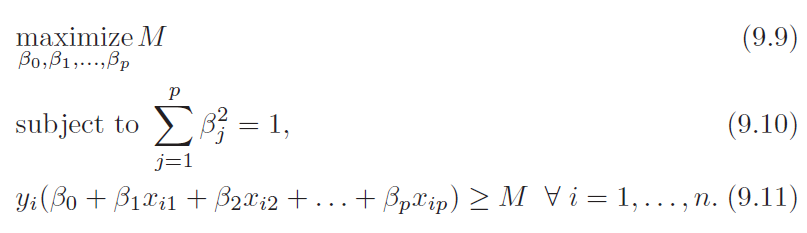
- Equation 9.10 ensures that left hand side of equation 9.11 gives perpendicular distance from the hyperplane
- Equation assumes y has two values (+1) and (-1)
Support Vector classifier
- Maximum margin classifier does not work when supporting hyperplane does not exist.
- Support vector classifier relaxes optimization objective to get that work
- Unlike maximum margin classifier this one is less prone to overfit as well
- The formal one is very sensitive to change in single observation
- Also know as soft margin classifier
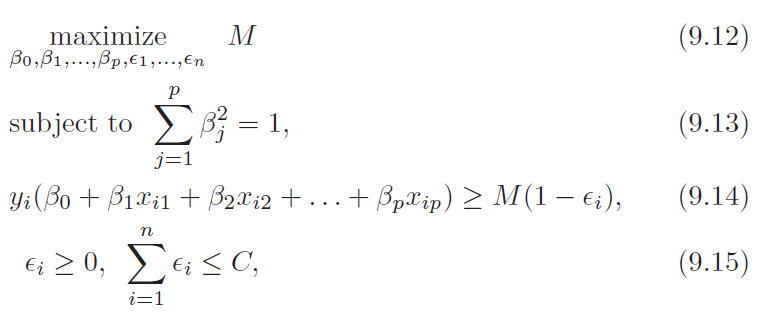
- ε variable allows training point to be on wrong side of margin
- If ε > 0 it is on the wrong side of margin
- If ε > 1 it is on the wrong side of hyperplane
- Parameter C is the budget that constraints how many points are allowed on wrong side of hyperplane
- C is selected with cross validation and controls bias variance trade off
- Point that lies directly on the margin or on the wrong side of margin for their class are called support vectors
- Because these points affects the choice of hyperplane
- And this is the property which makes it robust to outliers
- LDA calculates mean of all the observation
- However LR is less sensitivity to outliers
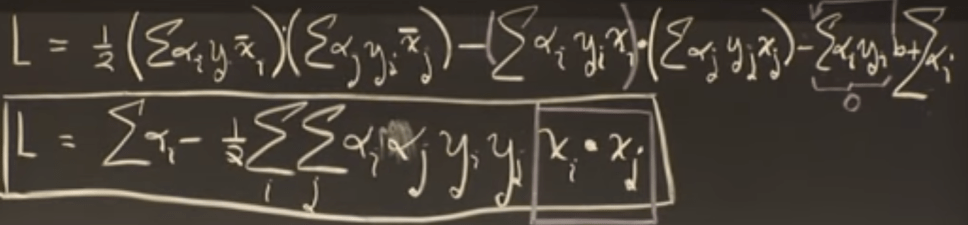
- Computation note – when we try to solve above optimization problem with lagrange multiplier we found that it depends on dot product of training samples
- This will be very important when we discuss support vector machine in next section
- Dot product is only with support vector, both while training and while solving [1]
Support vector machine
- Above two classifier does not work when desired decision boundary is not linear
- One solution is to create polynomial features (as we generally do for LR)
- But fundamental problem with this approach is that how many and which terms you should create
- Also creating large number of feature raises computational problem
- For the case of SVM, that fact that it involved only dot product of observation allows us to perform kernel trick.
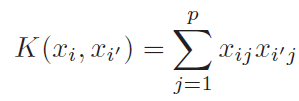
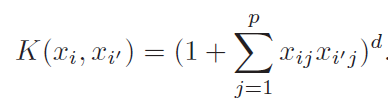
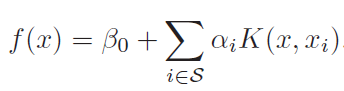
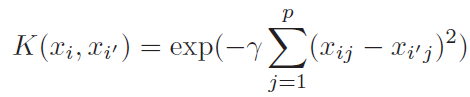
- Kernel acts as similarity function
- Above equation makes it clear that we are not calculating(and storing) higher order polynomial still taking the advantage of it
- Second one is polynomial kernel and last one is radial kernel
- This video shows visualization of kernel trick
Multiclass SVM
- One vs all and one vs rest is used for multiclass classification using SVM
Hinge Loss
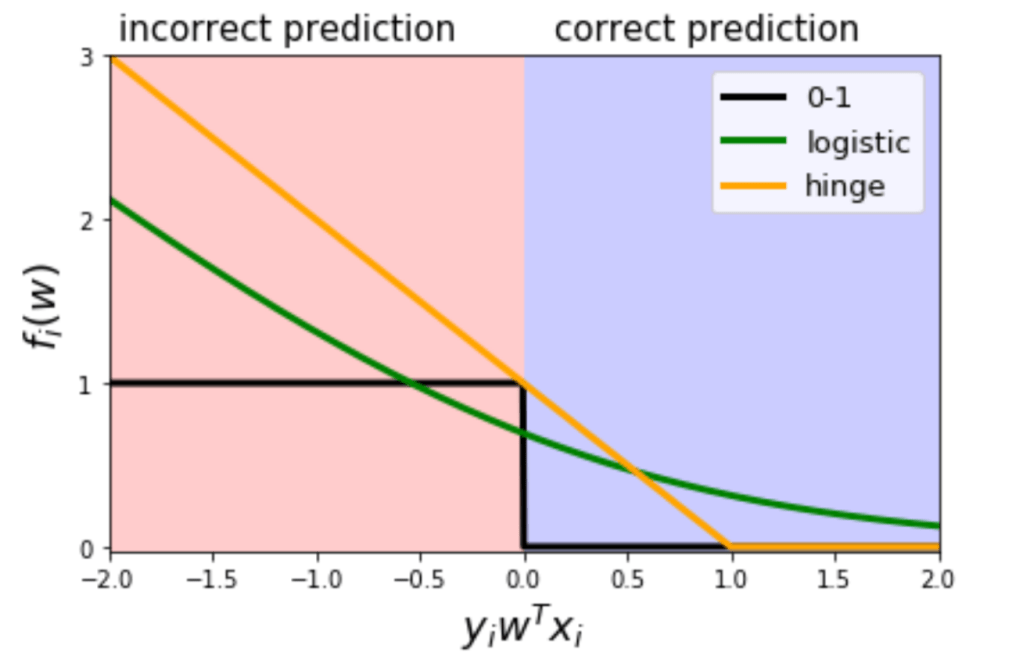
- Loss is 0 for w*x which are not support vectors
- Look at equation 9.14 and 9.15 above
- Looking at its property episilon, it relates to hinge loss
- Yet to check it in SVM lagrange solution though
- In hinge loss also we would predict +1 if w*x > 0 else -1
- Why not keep boundary at 0
- This can make w a zero to make positive training example right
- Zero parameter vector would mean while prediction we would always get 0
- Because prediction is w*x
- This makes it difficult to assign labels during prediction
- We keep boundary away from 0 to make zero we don’t get 0 parameter vector
References
[0] : An Introduction to Statistical Learning – http://www-bcf.usc.edu/~gareth/ISL/


2 thoughts on “Support Vector Machines”