
Formulas
Formula for multivariate gaussian distribution

Formula of univariate gaussian distribution

Notes:
- There is normality constant in both equations
- Σ being a positive definite ensure quadratic bowl is downwards
- σ2 also being positive ensure that parabola is downwards
On Covariance Matrix
Definition of covariance between two vectors:

When we have more than two variable we present them in matrix form. So covariance matrix will look like

- Above is very similar to how we compute sigma^2 in 1-D = (x – mu)^2
- Formula of multivariate gaussian distribution demands Σ to be singular and symmetric positive semidefinite, which in terms means sigma will be symmetric positive semidefinite.
- For some data above demands might not meet
Side Note
- Covariance is directional measure
- Correlation is scaled measure
- We normalise by individual variance
Derivations
Following derivations are available at [0]:
- We can prove[0] that when covariance matrix is diagonal (i.e there is variables are independent) multivariate gaussian distribution is simply multiplication of single gaussian distribution of each variable.
- It was derived that shape of isocontours (figure 1) is elliptical and axis length is proportional to individual variance of that variable
- Above is true even when covariance matrix is not diagonal and for dimension n>2 (ellipsoids)
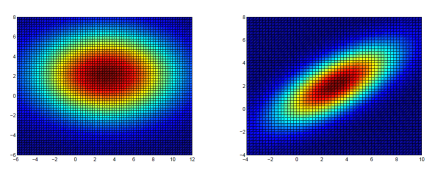
Notes and example of bi-variant Gaussian
https://github.com/arcarchit/datastories/blob/master/notes/bivariant_gaussian.pdf
First part above says that bi-variant destitution can be generated from two standard normal distribution z = N(0,1).
For any given k-variant Gaussian we can represent it as linear combination of k standard normal distribution. One simpler way to find these coefficient is Cholesky decomposition. Theorem 1 below stats the same thing.
This has a reference from [1].
Linear Transformation Interpretation

This was proved in two steps [0]:
Step-1 : Factorizing covariance matrix

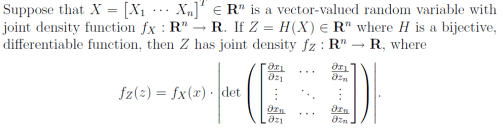
Step-2 : Change of variables, which we apply to density function
On Practical Example
Height, wight and waist size of men in US (Of course it weight can be negative, so it is approximately normal)
References
[0] http://cs229.stanford.edu/section/gaussians.pdf
[1] https://www2.stat.duke.edu/courses/Spring12/sta104.1/Lectures/Lec22.pdf

