
Sequence and Series
| Convergent Sequence
1/2, 2/3, 3/4, . . . , n/(n+1) Divergent Sequence 3, 9, 27, . . . . , 3^n Series => Partial Sum of sequence Convergent Series => if sum converges |
Convergence Test
|
Geometric Series
|
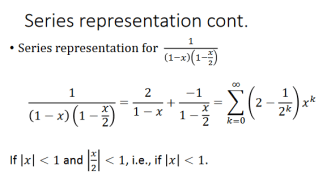
Representing function as (geometric) series
|
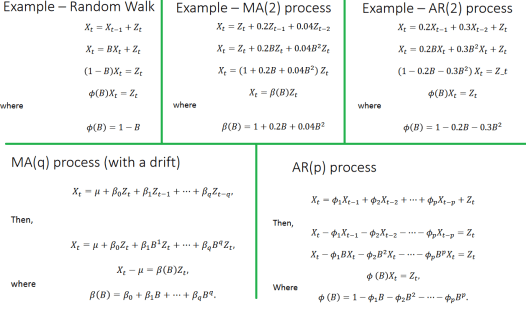
Backward shift operator
- B^kX(t) = X(t – k)
Invertibility
- Two models have same ACF
- Given ACF how to find out the model
- We will go for model that is invertible
- We can invert MA(1) into AR(∞)
- Inverting is basically act of expanding function in geometric series
- It is possible when growth r<1
- Out of two models only one satisfies this condition
- We will select that model given ACF
Conditions for Invertibility[MA(q)] and Stationarity [AR(p)]
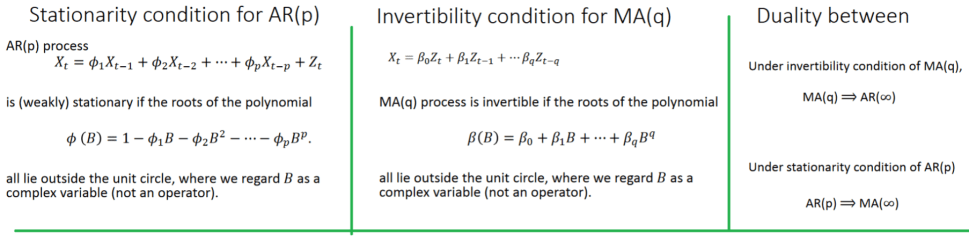
How to check if series is both invertible and stationary
- Check AR(p) polynomial for stationarity
- Check MA(q) polynomial for invertibility
- Both should hold
Reference


One thought on “Stationarity Conditions for MA(q) and AR(p) Processes”