
- AdaBoost stands for adaptive boosting
- Boosting is a technique for creating better classifier form several regular/weak/base classifiers
- Thought:
- We want to train second classifier in such a way that training data has more samples for the case where first classifier was wrong
- Third classifier will have more samples where first and second classifier contradicts
- How do we accomplish above:
- We assign weights to each sample
- This weights will be used in error function for each sample
- Error function would be sum of weights of incorrectly classified samples
- This weights keep changing in each iteration
- We also assign wight to each base (weak) classifier (α In below algorithm)
- Formula for calculating α below is valid for binary classification
- It will be different for multi class classification
- Formula for calculating α below is valid for binary classification
- We assign weights to each sample
- When do we stop iteration ?
- Combined classifier is predicting all sample correctly
- No more base classifier left
- Most machine learning algorithms allows to apply weight to data
- In logistic regression we can multiply weight in error fucntion
- In decision tree, classification error can be calculated by summing weights of missclassified samples
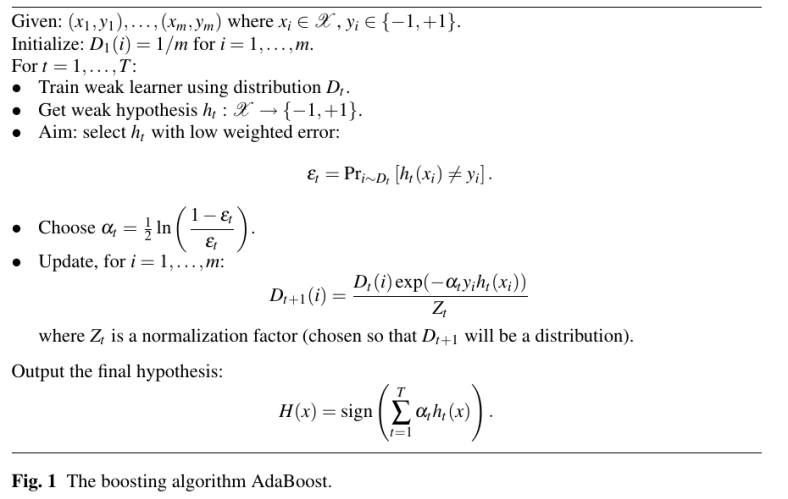
Formulations in above algorithm:
- Formula of α
- if ε=0.5 then α=0. It is just a random chance classifier.
- Else it can positive/negative.
- ε < 0.5 => negative α => we invert the prediction in weighted average
- Formula of D_(t+1)(i)
- y*h is just a sign
- y and h are {-1, 1}
- y*h will be positive for correct prediction
- Why it is function of ε
- Random classifier updating weights does not make sense
- y*h is just a sign
- By Z_t we are normalizing weights, which ensures numerical stability
Adaboost Theorem
- Error -> 0 as no of iteration -> infinity at certain condition
- Condition is here is that each learner has error < 0.5
- Each iteration means adding one weak learner
Over-fitting
- Contrary to weak classifier (decision stumps) we saw that rate of increase test error is less with boosting
- However no of iteration still should be selected via cross validation for small data-set and validation for large data-set
References:
Click to access MIT6_034F10_boosting.pdf


2 thoughts on “AdaBoost”