Basic Transformer
- Symbols
- B – batch size
- L – sequence length
- d_model – embedding dims
- Step 1 – input pre-processing ( embeddings and position )
- get token embedding
- get pos embedding of size d_model for each token as func(pos, index)
- there are d_model(say 128) index for each each token
- even index with sign and old with cosine
- Step 2 – Multi head projection
- Query, Key and Values
- Different metrix for each attention head
- If k heads, d_k = d_model / k
- Intuition
- allows model to look at same sentence from multiple affront angles in parallel
- Group of experts looking at painting
- one expert looks at colors
- another at shops
- 3rd historical context of artist
- Query, Key and Values
- Step 3 – Attention equation
-
- Intuitions
- 1) query matches all keys softly ( weight 0 to 1 ), values are multiplied by the weight and summed
- In python dictionary, query matches just one key, returning its value
- 2) query – what am I looking for ?
- key – what do I contain ?
- value – what information do I provide ?
- 1) query matches all keys softly ( weight 0 to 1 ), values are multiplied by the weight and summed
- Intuitions
- Step 4 – head aggregation
- concat and project
- intuition
- head never talked to each other before
- weighed matrix act as committee chair
- Step 5 – residual connection and layer norm
- Step 6 – Position wise FFN
- Token wise, there is no mixing
- Same weight applied to each token
- Two linear transformation
- Expansion-contraction loop
- First one has activation, second one does not
- Intuition
- 1) Information funnel
- expansion creates features
- activation selects those
- contraction brings them back to match residual connection
- ReLU after contraction will clamp negative values to zero resulting in information loss
- 2) Residual connection
- Model will loose ability to subtract value, dampen signals or reverse feature directions
- 3) Separation of concerns
- Attention layer as token mixer
- Look across and let tokens talk to each other
- FFN layer as channel mixer
- Look inside individual token’s vector to process its features
- Attention layer as token mixer
- 1) Information funnel
- Token wise, there is no mixing
- Step 7 – second residual connection
- Intuition of residual connections
- 1) Arch argument
- Creates residual stream, nothing overwrites, everything accumulates
- Allows to learn identify function
- without it, it becomes hard to reconstruct input using non linear weights
- Preserving low level features ( position, syntax )
- deeper layer extract higher level semantic meaning like sentiment
- 2) Optimization argument
- Avoid vanishing in deep networks
- even if gradient through complex layer shrinks to 0, +1 guarantees gradient can pass till first layer
- Avoid vanishing in deep networks
- 1) Arch argument
- Math behind attention scaling
- when d_k grows large, dot product grows large in magnitude, pushing softmax to region with extremely small gradients ( vanishing gradient problem )
- Mathematical proof shows variance of d_k and std deviation of sqrt(d_k)
- We kept the variance of 1, we don’t want to loose expressive power either
Norms
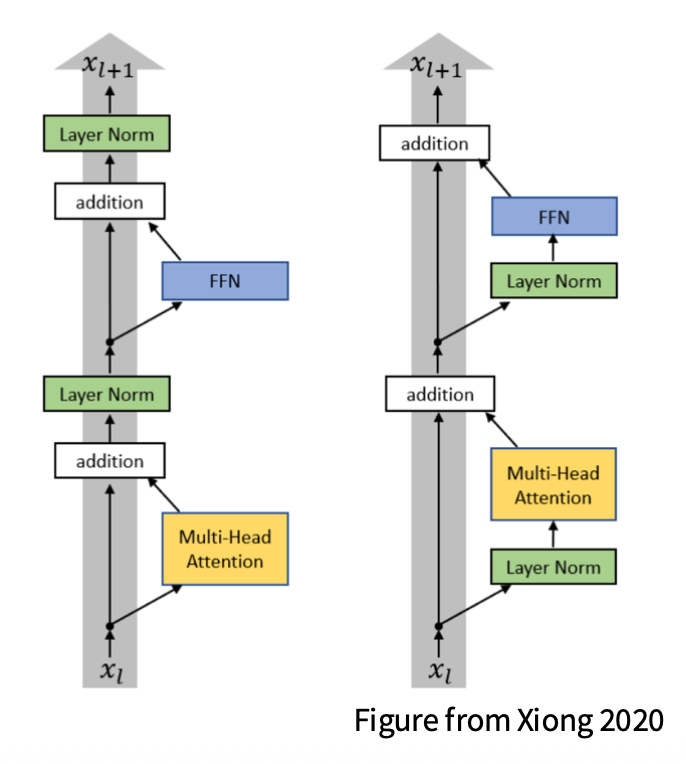
- Moved layer norms in the residual branch, keeping the highway clear.
- Its also called pre-norm
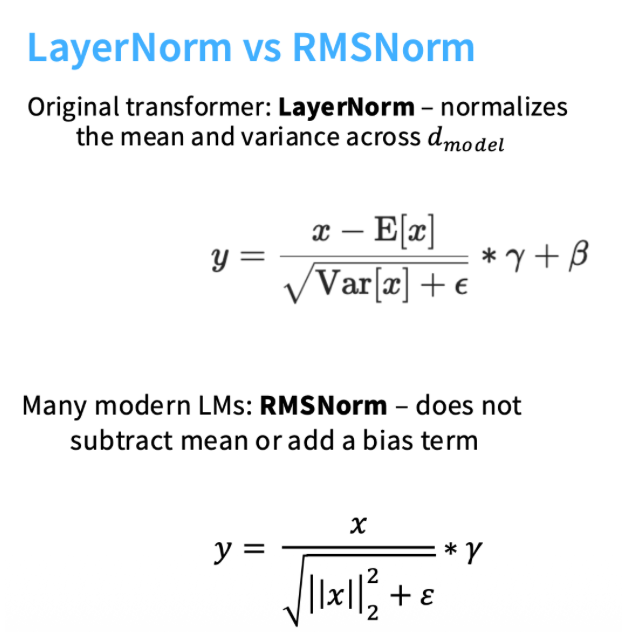
- Recent models are moving from layerNorm to RMS because
- 1) Few params means better bandwidth utilization ( memory bandwidth being GPU perf bottleneck )
- 2) Single pass kernel fusion
- don’t need to calculate and store mean
- 3) Fewer intermediary states in memory for backprop
- Inspired by this people are dropping bias terms too
- On batch norms
- Not used in transformers
- Batch statistics are unstable and unreliable for variable length data ( padding zero skews mean, variance )
- Autoregressive decoding makes it impossible
Position Embeddings
- RoPE
- Rotary position embeddings
- Goal – relative position <f(x,i), f(y,j)> = g(x, y, i-j)
- The distance between token matters, wherever they occur in the sentence
- Core idea
- We know inner product are invariant to arbitrary rotation
- Position i vector gets rotated by i position
Activation Units
- Gated activation units
- ReLU shuts down some channel in single shot
- 𝐹𝐹 𝑥 = max(0, 𝑥𝑊 1 )𝑊 2
- GLU allows to do that as a function, looking at all channels
- FFReGLU 𝑥 = (max (0, 𝑥𝑊 1) ⊗ 𝑥𝑉) 𝑊 2
- ReLU shuts down some channel in single shot
- GLU idea can be applied to GeLU and Swish as well
- Which results in GeGLU and SwiGLU
- On their own GeLU and Swish are self gated – x is multiplied by gate computed from x itself
- Swish = x * sigma(beta * x)
- GeLU = x * phi(x)
- GLU unities two giving gate, its own weight and more freedom
Group query attention
| Attention Type | Query Matrices | Key Matrices | Value Matrices |
|---|---|---|---|
| Multi-Head (MHA) | H distinct matrices | H distinct matrices | H distinct matrices |
| Grouped-Query (GQA) | H distinct matrices | G distinct matrices (G < H) | G distinct matrices (G < H) |
| Multi-Query (MQA) | H distinct matrices | 1 shared matrix | 1 shared matrix |
- Intution
- MHA – asking 32 detective to solve mystery, asking them to read same book from personal topic
- GQA
- 8 groups of 4
- Every 4 heads share single key/value ( shared book )
- Unique query matrix means detective still form their individual conclusions
- Advantages
- Very successful, performance close to MHA
- Reduces KV cache size
Mixture Of Experts
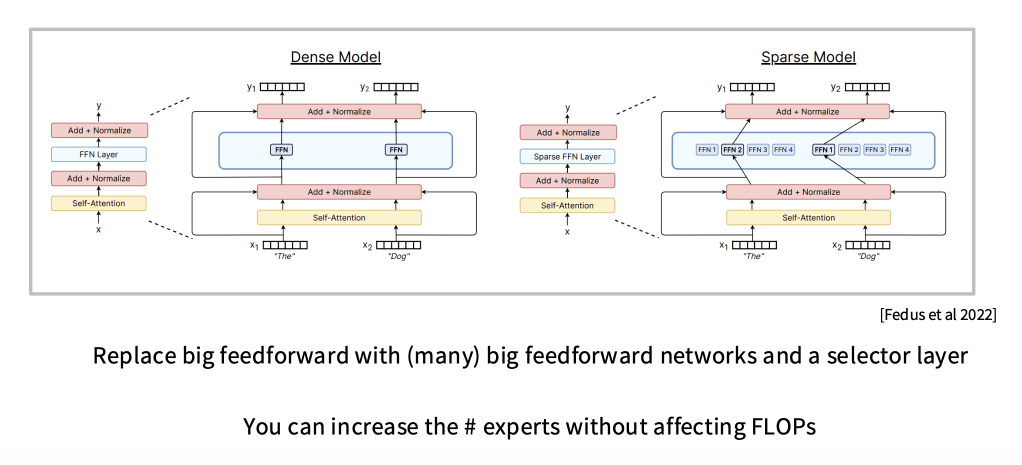
- Different FFN layer for different tokens
- Not at the sentence level
- Router is important architecture component
- Decides which token should go to which expert
- Top k based on inner product
- Most common approach
- Have some learnable weight vector for each expert
- Use softmax to select it, given its differentiable gradient can propagate back
- But “topK” is not
- problem of “expert collapse” – some experts are abandoned
- Noisy gating, add some gaussian noise to dot product logits before “topK”
- RL to learn router
- Lot of overhead, not used anymore, 2013 paper
- Hashing
- Simple yet works
- Top k based on inner product
- Decides which token should go to which expert
- Intuition
- Receptionist at hospital route to expert doctor
- You don’t ask everyone yourself
- Sparse activation
- Only tiny fraction of model is activated for a given token
- Receptionist at hospital route to expert doctor
- Key Ideas
- Specializaton
- Individual sub network naturally learn to specialize – code, grammar, language
- Router
- Assigns probabilities
- Separating size from cost
- Scale model params without cost
- Specializaton
- Main advantages
- Scale without FLOPs
- Parallizable across devices
- GPU 0 hosts expert 1 and 2
- Earlier we were slicing the matrix
- Memory bottleneck
- Results are showing improvement by keeping the params constant with MoE
On Regularization
- SGD with single pass is haed to memorize
- In the compute constraint deep learning its not needed
- Dropout is not used anymore
- But weight decay ( L2 regularization) is still used with different purpose though
- Studies have shown that it helps with optimization
Sparse/Sliding Window Attention
- Instead of entire attending entire context, can we focus on some nearby ( sliding windows )
- Standard practice –
- Interleave full and local attentions
- Ex – one full attention after every 3 layers

